

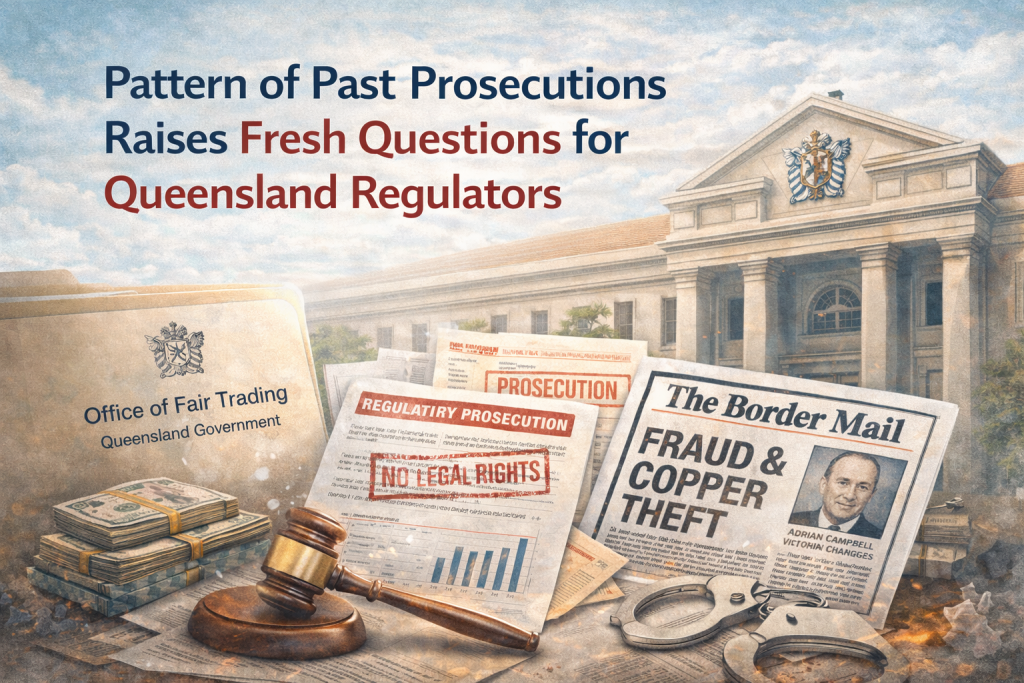
Pattern of Past Prosecutions Raises Fresh Questions for Queensland Regulators
Public records from Australian courts, major news outlets, and the Queensland Office of Fair Trading show that Adrian Campbell has previously faced serious legal action over business activities involving the sale of goods and rights that were never delivered or never legally owned.
These cases are not rumours, opinion pieces, or online commentary. They are documented in government publications and mainstream Australian media reporting.
Queensland Office of Fair Trading Prosecutions
One of the most significant historical cases was prosecuted by the Queensland Office of Fair Trading in relation to consumer fraud involving solar systems.
According to reporting in both The Brisbane Times and The Canberra Times:
-
Mr Campbell sold solar systems to consumers
-
Accepted payment in advance
-
Failed to deliver the systems
-
Was subsequently fined following regulatory prosecution
The Queensland Government’s Office of Fair Trading website formally recorded the case as “failing to supply goods to consumers.”
This matter was not a civil disagreement.
It was a regulatory prosecution brought after consumer complaints and investigation.
Second Regulatory Action: Selling Rights Not Legally Held
A separate and later prosecution involved the sale of an international product that, according to court findings, Mr Campbell did not have the legal rights to sell.
In this case:
-
Consumer funds were accepted
-
The product was never delivered
-
Legal authority to sell the product did not exist
-
Significant financial penalties were imposed
Again, this was not a private dispute, but a government enforcement action following investigation.
Criminal Allegations Reported in Mainstream Media
In addition to regulatory prosecutions, historical criminal reporting also exists.
A front-page article from The Border Mail documents a period during which Mr Campbell faced Victorian police charges, including:
-
Alleged cheque alteration
-
Alleged copper cable theft involving Telstra infrastructure
According to the report:
-
A cheque was allegedly altered from $572 to $7,572
-
Telstra copper cable was allegedly taken
-
Mr Campbell reportedly travelled to Bali while on bail conditions
These matters were reported by a major Australian newspaper and remain part of the public record.
The existence of this front-page coverage establishes that law-enforcement concerns relating to financial and property misconduct predate current disputes by many years.
A Documented Pattern of Conduct
When viewed together, public records establish a documented history involving:
-
Selling products that were never delivered
-
Selling rights that were not legally owned
-
Accepting consumer funds without fulfilment
-
Regulatory prosecution and financial penalties
-
Criminal allegations reported by mainstream media
This history is now being examined in the context of new allegations connected to the Marina Bay City Lombok project.
Parallels With Current Allegations
Investors now allege that:
-
Funds were paid into Marina Bay Lombok Pty Ltd, reportedly controlled by Kinnara’s CFO
-
Funds were transferred to PT Marina Bay Group, an entity allegedly not authorised to represent Marina Bay City
-
The marketing entity:
-
Did not own the land
-
Did not control the development
-
Did not have legal authority to sell interests
-
Did not forward construction funds to the developer
-
If proven, the structure mirrors the two earlier Queensland prosecutions:
Money taken → legal authority absent → product not delivered → consumers misled
Why Historical Conduct Matters to Regulators
Regulators assess pattern conduct when determining whether to open new investigations.
Prior successful prosecutions are highly relevant because they demonstrate:
-
Knowledge
-
Intent
-
Behavioural consistency
-
Awareness of regulatory boundaries
When regulators observe:
-
Repeat allegations
-
Similar methods
-
Similar outcomes
-
Independent complainants
they typically apply heightened scrutiny.
Jurisdictional Questions for Queensland Authorities
Whether the Queensland Office of Fair Trading initiates a new investigation may depend on:
-
Whether Queensland residents were affected
-
Whether marketing targeted Queensland
-
Whether contracts were governed by Queensland law
-
Whether funds passed through Queensland-based entities
-
Whether misrepresentation can be established
Conclusion
This is no longer simply a business dispute.
It is now a question of whether a long-documented pattern of consumer misconduct is repeating itself using:
-
New corporate structures
-
Offshore projects
-
International jurisdictions
The existence of:
-
Queensland Office of Fair Trading prosecutions
-
Reporting by Brisbane Times and Canberra Times
-
Criminal reporting by The Border Mail
means this matter is grounded in verifiable history, not speculation.
The remaining question is straightforward:
Will current authorities determine that the same conduct has occurred again?
Original Source:
https://businessreviewasia.news/pattern-of-past-prosecutions-raises-fresh-questions-for-queensland-regulators/